 TIẾNG VIỆT
“Vietnam is an attractive market for premium banking services” says Nuno Matos, Chief Executive Officer, Wealth and Personal Banking, HSBC

Mr. Nuno Matos, Chief Executive Officer, Wealth and Personal Banking at HSBC. Photo: Quy Hoa
The driven, young, rising middle-class population in the fastest-growing economy in the region, is making Vietnam an attractive market for premium banking and wealth services. Mr. Nuno Matos, Chief Executive Officer, Wealth and Personal Banking at HSBC, explains.
What’s your view on Vietnam’s wealth and personal banking market?
Vietnam’s population is approaching 100 million people, and its economy is growing at a rapid pace, averaging 6% to 7% per year spurred by trade, strong FDI, and favorable demographics. One of the core factors is the country’s growing ‘middle segment’. Our own research shows that over two million Vietnamese may well own at least USD500,000 in wealth by the end of the decade, surpassing Singapore’s total. Moreover, the recent Knight Frank 2022 Wealth Report forecasts a 56% surge in Vietnam’s high-net-worth population and a 26% increase in ultra-high-net-worth individuals from 2021 to 2026.
Rising incomes translate into affluence and in turn, evolving needs across all segments of society. We expect this structural growth to precipitate demand for banking and wealth products and solutions. This is a compelling opportunity to be our customers’ financial partner as they progress in their wealth journey.
What is the driving force for Vietnam to enjoy such impressive economic growth?
 |
We can attribute this growth to the culmination of a number of drivers. Foreign direct investments continue to flow into the country at a critical time for global supply chains, leveraging the Government’s initiatives aimed at welcoming international investors as well as its current emphasis on national core industries after two years of pandemic-related disruption.
I would also point to the emphasis that Vietnam’s Government is placing on “green growth” in the face of huge challenges caused by climate change. Last year at COP26, Vietnam took the important step of committing to net zero by 2050. We are very pleased to support these initiatives, in part through our commitment to arrange up to USD12 billion of direct and indirect sustainable financing for Vietnam and the corporate sector in Vietnam by 2030.
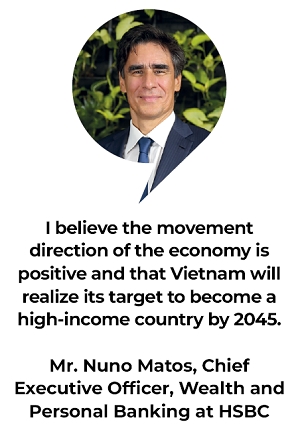
In summary, I believe the direction of the movement is positive and that Vietnam will realize its target to become a high-income country by 2045.
Could you please evaluate the potential of the affluent customers in Vietnam in comparison to other countries in the region?
It’s fair to say that the growth of the affluent population in Vietnam and, indeed, across Southeast Asia, presents a real opportunity for us to expand our affluent client base over the coming years in line with our ambition to become Asia’s leading wealth manager for the full spectrum of customers.
This is a multi-year ambition, backed by over USD3.5 billion in investments from HSBC, with Vietnam as a beneficiary as we expand and deepen our presence throughout Southeast Asia and the wider region.
This level of commitment reflects our bullishness towards Asia as a whole, where we continue to believe that wealth growth will outpace the rest of the world making it one of the most compelling opportunities in consumer banking today. Our results reinforce this view. For example, Asia accounted for 89% of the USD32 billion of net new invested assets our Wealth business brought in globally in the third quarter of this year.
What’s HSBC’s plan for Vietnam’s market in the upcoming time?
Currently, HSBC is the only international bank that provides retail and wealth management services in Vietnam. We are doubling down on our strategy to serve the country’s middle-class and affluent populations with the needs of family and global mobility privileges. With a strong international proposition and best-in-class Premier Relationship Managers, we continue to provide a well-rounded suite of banking and wealth management solutions worldwide to cater to the aspirations that our customers are building for themselves and their families.
We have also observed increased spending and borrowing by the middle class and affluent segments. Our aim is to become a leading player in Vietnam’s credit card market.
Similarly, given Vietnam’s rapid rate of urbanization, housing demand will continue to increase. And in a country and culture where home ownership is a priority, we aim to serve this need through our mortgage business.
What’s your view on the next generation of consumers – Gen Z?
Undoubtedly, the next generation is tech-savvy. These are customers who embrace digital banking, they embrace very agile ways of interacting with banks, and they are very much engaged in sustainability, especially with their increased awareness of climate change and its impact.
It’s important to recognize today that with Gen Z, a new type of consumer culture is emerging and that these customers will constitute the majority of the Vietnamese population in 20 years’ time.
We are acting today for tomorrow. We are digitalizing all our services and processes – front-to-back – to ensure that every service a customer requires can be accessed through their mobile phone. But, of course, when a customer needs to speak with someone for advice and a smile, they can still go to one of our branches.
Could you please share with us the key trends that are shaping the future of the retail banking market?
I would highlight three key trends. The first, as I have discussed, is the rise of the middle class. Currently, Vietnam’s GDP per capita stands at around US$3,600 with a growth rate of 10%. This indicates a population with rapidly developing wealth needs spanning investments, planning, and protection. As with similar markets, we would also expect to see growing sophistication in those wealth needs, for example, demand for a wider range of investments for portfolio diversification.
 |
| Currently, HSBC is the only international bank that provides retail and wealth management services in Vietnam. Photo credit: HSBC |
The second trend is the digitalization of banking services. Customers want the option of banking from the comfort of their homes or on the go, on their mobile devices. Our consumers are quick to adapt to contactless, online ways of fulfilling their consumption needs. They are also more comfortable communicating and collaborating virtually. That’s why everything we do today goes mobile-first. Our model is people plus technology.
The third is the rise of ESG and the critical need to think and act sustainably. The banking industry has an important role to play in financing a net zero economy. This includes helping individuals make more responsible consumption and investment decisions that contribute to a sustainable society.