 TIẾNG VIỆT
 Clean water: a new battleground for private sector
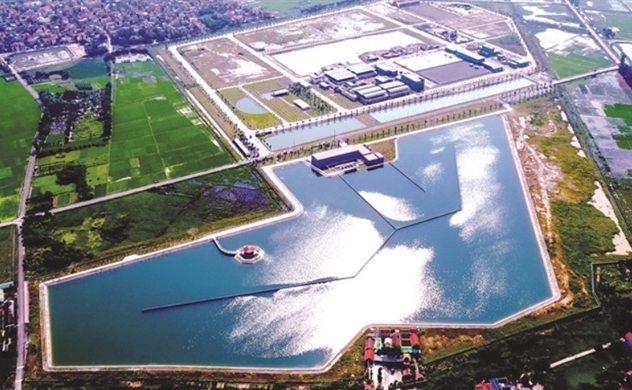
Photo: vneconomy.vn
Speedy urbanization in big cities turns clean water into an attractive market for those who want to turn water into gold. The business has attracted investments from companies without background or experience on the water sector.
Clean water companies had a good year with positive profit reports in 2018. Most water enterprises have good profit margins, at around 30 to 40%. According to a report from HSC Securities Company, the annual growth rate of the water sector between 2017-2020 was 43% for industrial production and 36% household consumption.
Thanks to the wave of equitization, the business prospect of the industry has changed into a positive direction since several strong investors see the attractiveness of this business. Dong Nai Plastic Company, one of the enterprises want to enter the water sector through a merger and acquisition.
Since 2018, the company has been injecting considerable amount of money in dozens of water companies in several provinces and cities including Hanoi, Can Tho, Binh Thuan, Long An, Bac Giang, Tien Giang, Tay Ninh, Ca Mau ...
This company's clean water portfolio is expected to double in the next 5 years. Water is expected to become main incomes of the company, offsetting the decline in plastics industry.
Aqua One Group, a company of businesswoman Do Thi Kim Lien, known as Shark Lien, is another name in this promising sector. The company has ambition to become a dominant player in this market.
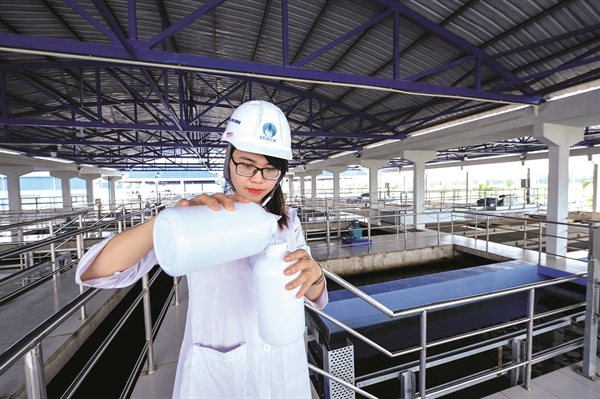 |
| Photo: Quy Hoa |
The group has recently invested $216.5 million on Duong river water project. Besides, the company has two other projects including the $82-million Song Hau water plant and the Xuan Mai water project in Hoa Binh province worth $130 million.
The water market also attracts investments from foreign financial institutions such as Oman National Investment Fund, VinaCapital, Dragon Capital, Olympus Capital Asia, Maybank Kim Eng.
Although the government holds the right to set water price, capital injected to clean water projects keep increasing. Thanks to steady increase in demands, the companies receive growing profit. Saigon Water Corporation reported 56% growth in pretax profit in the first half of 2019.
The Refrigeration Electrical Engineering Joint Stock Company (REE) maintainss outstanding performance thanks to significant contributions from water sector.
Currently, REE holds stakes in 4 clean water plants. These are key water production companies in large cities. In addition, REE also owns a series of water distribution companies such as Nha Be Water Supply Company, Gia Dinh Water Supply, and Thu Duc Water Supply.
REE's water profit is expected to reach $10 million this year and $11 million in 2020, an increase of 14.9% and 9.5% respectively, according to forecasts of BSC Securities Company.
Stable profits from clean water investment have attracted many several investors.
Clean water market has much room to grow. Currently, only 80% of the urban population and 39% of the rural population can access clean water, said Vu Dinh Do, cchairman of DNP Corp.
“Quality of underground water is degrading. The government’s policy to limit groundwater exploitation is the opportunity of water industry, ” added Do.
_7161104.jpg "Clean water: a new battleground for private sector") |
| Photo: Quy Hoa |
Bitter taste of clean water
Recently, thousands households in Hanoi unexpectedly faced water crisis due to contaminated water on Da river. This incident was not the first one. Previously, an enterprise that holds 35% of Hanoi's clean water market share had an unprecedented incident due to serious broken pipeline, causing heavy damage to consumers.
In contrast to unsatisfactory product quality, Viwasupco reported first 6 months net profit at $5.5 million, an increase of 31%. The company was formerly a member of the state-owned enterprise Vietnam Construction and Import-Export Corporation (Vinaconex). The water plant was put into operation in 2008 with a total investment of $65 million.
By 2025, Vietnam aims to reach the target of 100% citizen in urban areas can access clean water. It is estimated that between 2017 and 2022, the demand for clean water investment in Vietnam is $10 billion.
Pparticipation of pprivate sector helps to reduce financial burden on the State. However, it is seen that this approach has not been successful, even in the leading countries.
In the past decades, several cities in the US have joined the wave of transferring the role of providing clean water to private companies. However, the results were below expectation.
According to US economic experts, the privatization strategy of the water industry has created gaps. Most businesses prefer to increase selling prices for higher profit. Investors are not obliged to provide qualified water, since clean water is now considered a commodity in the market.
Same category news
-
-
 Huyen Hoang
 -