 TIẾNG VIỆT
 Richard Craik - 30 years following the birds of the wild
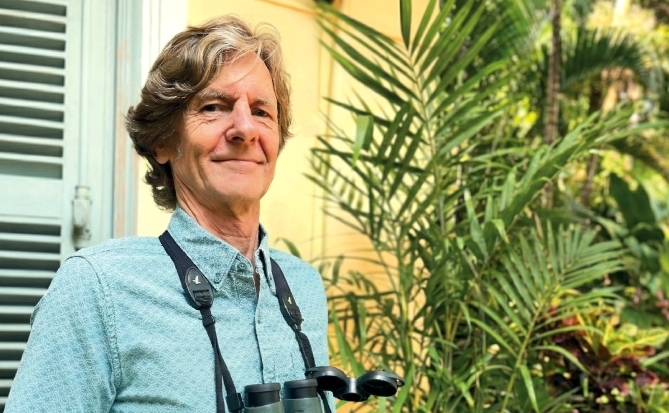
Mr.Richard Craik, Founder of Vietnam Birding.
With a gentle and respectful approach to nature, Richard Craik and his collaborators have had the opportunity to chart the birds of Vietnam, contributing to greater awareness and the conservation of this diverse ecosystem for future generations.
A “detective” journey through old-growth forests
When work began on the field guide Birds of Vietnam (2018), Richard Craik and co-author Lê Quý Minh unexpectedly found themselves becoming “detectives,” tracking down and verifying the presence of nearly every bird species across Vietnam. At the time, Richard was best known as a conservationist and founder of Vietnam Birding, a company specializing in birdwatching tours, while Minh served as the company’s chief guide.
Richard’s publishing partner was already behind the 17-volume Handbook of the Birds of the World, an ambitious series covering bird species worldwide. Yet the collection offered only broad overviews, lacking regional specificity and failing to reflect Vietnam’s endemic subspecies. Filling this gap became the task of the two authors.
“We classified species and subspecies and added new information”, Richard explained. “For example, birds of the same species may differ between populations found in different regions of the country in plumage, song, and sometimes behaviour too.”
One of the greatest challenges lay in creating accurate distribution maps. Each species required its own map, clearly indicating where it occurs. Prior to this, Vietnam had almost no comprehensive data at this level.
The scale of the work was formidable. Vietnam is home to more than 900 bird species, among the highest levels of avian diversity in the region. Of these, 99 species are of conservation concern, including 10 critically endangered, 17 endangered, 24 near threatened, and 48 vulnerable species.
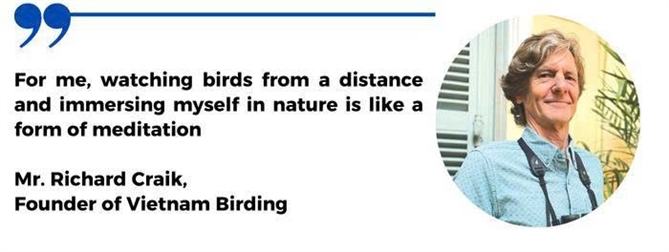 |
Birds of Vietnam is not merely a field guide, it is also an effort to fill long-standing data gaps on Vietnam’s endemic subspecies. Establishing distribution maps for more than 900 bird species provides a critical scientific foundation for conservationists seeking to monitor and protect this rich ecosystem amid environmental change.
“Over the course of 18 months, the two authors gathered data from Asian ornithological literature, social media posts, and their own exhaustive field of experience. In many cases, they traveled to sites in person to make final confirmations. Richard joked, only half in jest: “At that point, our work really did feel like detective work.”
It was no coincidence that a British national was entrusted with documenting Vietnam’s birds. Beyond passion and expertise, Richard Craik possessed an advantage few foreign specialists could claim: he had lived in Vietnam longer than he had lived in his own country. For more than three decades, he quietly traversed old and young forests across the country, devoting much of his life to observing birds, guided by a principle of observation without interference.
“For me, watching birds from a distance and immersing myself in nature is like a form of meditation”, he said. “The observer is fully focused on listening and watching, undistracted by electronic screens, like when using a camera. It allows the mind to relax and connect with the environment in a healthy way.”
 |
This gentle, respectful approach led Richard to an unexpected career turning point. On a Vietnam Birding tour, one participant happened to be the founder of the Barcelona-based publishing company behind the "Handbook of the Birds of the World". That encounter opened the door to collaboration, and soon afterward, Richard and Lê Quý Minh were invited to take on the project of authoring the first comprehensive field guide to the Birds of Vietnam.
Placing hope in the young
Reflecting on his arrival in Vietnam in 1992, Richard recalls a less densely populated country with a far slower pace of life than today’s bustling cities. Over the next three decades, Vietnam’s population grew from around 70 million to over 100 million, placing increasing pressure on residential and agricultural land. Urban transformation came hand in hand with less optimistic stories about the environment and biodiversity.
“Over the past 30 years, we’ve lost vast areas of forest and habitat”, Richard noted, referring to highland forests cleared to make way for coffee plantations. Destinations such as Đà Lạt and Sa Pa are no longer as suitable for birds as they once were, following rapid and poorly controlled tourism development. He noted that just five or six years ago, the endemic Orange-breasted Laughingthrush, that is only found on the Dalat Plateau in Vietnam, was still regularly seen on tours, but due to recent trapping and habitat loss has now all but disappeared.
Still, Richard has observed reasons for optimism. Cát Tiên National Park stands out as one of the rare places where biodiversity is genuinely better than it was 30 years ago, thanks to strict protection. Some species have made remarkable recoveries: the Green Peafowl (Cong), once rare, is now common in the grasslands at the park, and a species of wild cattle, the Gaur (Bo Tot), has also made a spectacular comeback at Cat Tien. Another success story has been the reintroduction of the Siamese Crocodile, extinct for many years in Vietnam, but now thriving at the park’s Crocodile Lake (Bau Sau).
Even the recent increase in visitor numbers at Cát Tiên does not overly concern him. Human presence, he believes, has been sufficiently well managed to avoid placing pressure on wildlife. “Visitors mostly stay on designated routes”, he explained, referring to paths leading to Bàu Sấu and grassland areas accessible by bicycle or on foot. This ensures that much of the deeper habitat remains naturally quiet.
Beyond nature itself, social awareness has also shifted. “What makes me most optimistic is the younger generation”, Richard said, referring to those under 25-30 who are increasingly concerned about climate change and pollution, and who reject the consumption of bushmeat or wildlife products. In contrast to earlier generations, many of whom kept birds in cages or consumed wildlife as delicacies, young people today prefer to explore forests and observe birds and other wildlife in their natural habitats.
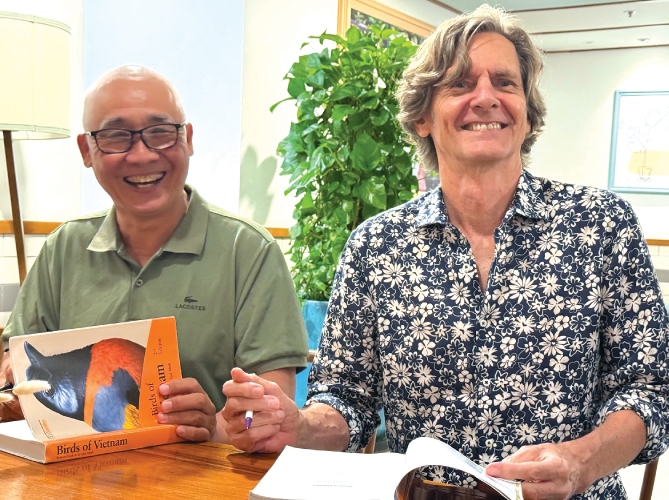 |
| Le Quy Minh and Richard Craik signing the books together. |
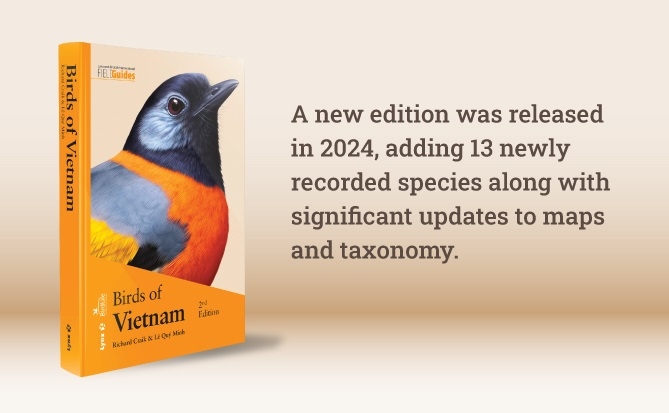
As for himself and others of the older generation, Richard and his colleagues continue their quiet work of monitoring and recording Vietnam’s birds. Six years after Birds of Vietnam (2018), a new edition was released in 2024, adding 13 newly recorded species along with significant updates to maps and taxonomy. He hopes the revised edition will remain a reliable reference for bird enthusiasts, scientists, students, and all those interested in Vietnam’s avifauna.
Without hiding his pride, Richard concluded: “With growing numbers of young people taking an interest in birdwatching, and greater awareness and more responsible practices, we can help protect Vietnam’s unique birdlife, and ecosystems for future generations.”
|
Recording Vietnam’s nature through the friendship of two birdwatchers If outsiders find Richard Craik and Lê Quý Minh’s shared passion for birds intriguing, Minh himself often recalls something even more interesting. Whenever he speaks of his longtime collaborator, he likes to tell the story with a touch of amusement that in the early 1990s, foreigners arriving in Vietnam were often given a Vietnamese name by friends. By coincidence, Richard’s Vietnamese name at the time happened to be… Minh. That year, the two had not yet met. Their first meeting between the two “namesakes” took place a few years later, in 1999, at Bạch Mã National Park. Minh was then working as a guide-receptionist, while Richard was in the travel industry and collaborating with WWF to develop ecotourism maps for national parks. Richard visited Bạch Mã on a survey trip, and that very afternoon, the two went birdwatching together for the first time. From then on, Richard and his wife returned to Bạch Mã regularly, twice a year, staying three to four days each time to follow Minh deep into the forest. The journeys soon extended beyond Bạch Mã to neighboring areas in central Vietnam, then across the country, and even overseas. To this day, the habit remains, though less frequent. “Every now and then, we still ‘sneak away’ from our families, wandering through the mountains and forests for an entire week, following the trail of birds”, Minh said. What has changed most is their work. In 2007, Richard founded Vietnam Birding, while Lê Quý Minh left his position at the national park to become the company’s chief guide.
“I’ve known Richard for 27 years now. Two people of different nationalities who have stayed in close contact and worked so closely together, that’s a kind of destiny”, Minh said. “Between us, there’s no concept of boss and employee, only respect, understanding, and mutual support. If something isn’t clear, we ask and discuss it openly.” That spirit of trust and respect carried through to their collaboration on Birds of Vietnam (2008), the first field guide dedicated exclusively to Vietnam’s birds. An updated edition followed in 2024. “Neither Richard nor I studied biology, and neither of us is a writer who can simply sit down and produce text”, Minh shared. But thanks to nearly two decades of field experience, observing species behavior, mapping distributions, and updating scientific data from multiple sources, they built a solid database robust enough to be published. “When I first held the book in my hands, I felt so excited and proud”, Minh recalled. “Normally, I never post my work on Facebook, but that day, I photographed the cover and shared it immediately.” He takes pride in the fact that the book was not created for commercial gain, but to inspire bird lovers and make data more accessible. Birds of Vietnam is the culmination of many years in the field, countless journeys, and a rare professional friendship between Lê Quý Minh and Richard Craik. “This experience is an intangible spiritual value, bringing greater fulfillment than any economic goal could ever offer”, said Lê Quý Minh, Chief Guide, Vietnam Birding. |
_31442141.png "Richard Craik - 30 years following the birds of the wild")
Same category news
-
 Hong Thu - Bao Han
Ms. Luu Bao Huong, Chairwoman of GG Corporation: Logic guides, the heart ...
-

-
 Architect Pham Minh Nhut