 TIẾNG VIỆT
 VIEF Identifies Gaps in Vietnam’s Education Landscape

As of 2022, fewer than 30% of Vietnamese workers had professional skills, and only around 10% met business needs for digital transformation (World Bank). Photo: freepik.com
In a recent human-resources event taking place in Ho Chi Minh City, more than 100 businesses, employers, academic institutions, and technology experts filled a packed hall. They deliberated over a hot topic that shows no sign of cooling, which is how to harness artificial intelligence (A.I) without losing the essence of human values. Across workforce and education forums, this concern has steadily gained attention, and debates continue to intensify.
Indeed, as of 2022, the share of Vietnamese workers with professional skills remained below 30%, and only about 10% were considered to meet enterprise requirements amid digital transformation, according to the World Bank. This reality underscores the need for workers to continuously update their capabilities. It also means the education system, where the foundations for the workforce are first formed, cannot remain on the sidelines.
The Skills Gap
Despite several waves of reform, Vietnam’s education system continues to face pressure to keep pace with changes in the labor market and the advance of digital technologies. The 2018 general education curriculum represents the latest step in that direction, carrying expectations that it will gradually help bridge this gap.
Dr. James MacNeil, Senior Advisor to Vietnam Innovation of Education Foundation (VIEF), believes that community-driven education initiatives and years of reform have created positive momentum: “Thousands of children in disadvantaged areas now have access to schooling, and Vietnam’s PISA results in mathematics, science, and reading have consistently ranked high, surpassing many OECD countries.”
However, Dr. Dang Tu An, former Deputy Director of the Primary Education Department (MOE) and Founder of VIEF, believes the biggest shortcoming of the 2018 curriculum lies in its ability to keep pace with learners’ technological competency needs. “Earlier reforms mentioned computer literacy, but that is no longer sufficient. Modern trends require much broader digital and A.I. competencies,” he noted.
In reality, disparities in educational quality across regions, shortages of qualified teachers, and training programs that remain heavy on theory compared with market skill requirements continue to persist. As a result, many students complete their studies yet still struggle to access employment opportunities.
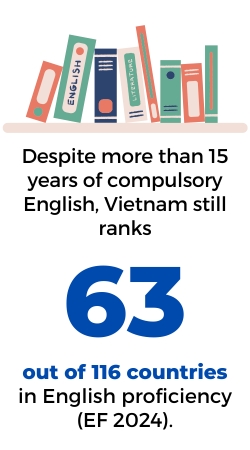 |
Foreign-language proficiency is one telling example. Despite more than 15 years of compulsory English instruction from primary school, Vietnam’s English proficiency still ranks just 63rd out of 116 countries, according to Education First 2024, far behind Singapore, the Philippines, and Malaysia, where English is embedded in everyday life.
Vietnam is also trying to keep pace in the AI era, yet its ICT development index stands at 108 out of 176 countries (International Telecommunication Union). Infrastructure has improved, but technology access and readiness vary widely across schools, teachers, and students.
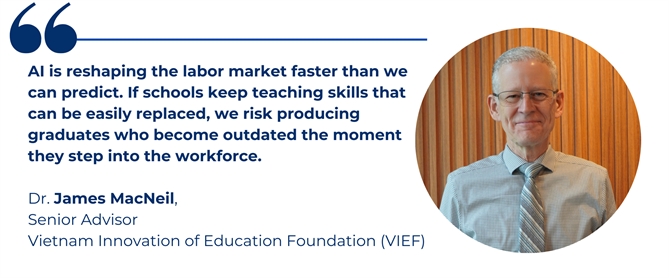
“AI is reshaping the labor market faster than we can predict. If schools keep teaching skills that can be easily replaced, we risk producing graduates who become outdated the moment they step into the workforce,” MacNeil said.
These are only two snapshots of a much broader set of challenges that Vietnam’s education system is facing in the digital age.
Taking a closer look into classrooms, academic pressure and rankings continue to weigh heavily on teachers and students. The Vietnam National Adolescent Mental Health Survey (V-NAMHS 2023) found that one in five adolescents has experienced mental-health issues. Meanwhile, a 2024 study by the Institute for Policy Development at Vietnam National University, HCMC, covering more than 12,000 teachers, reported that 70% felt overwhelmed and over 40% had considered leaving the profession due to pressure from parents.
These challenges have also spurred a range of educational support initiatives, from communities and non-governmental organizations to development funding and expert networks.
 |
VIEF’s Interventions
For VIEF, the “Happy Schools” initiative has been selected as a central pillar. Supported by the Ministry of Education and Training, the model is built on a UNESCO framework but adapted to Vietnam’s context.
“We aim for a balance between intellect, emotion, and a healthy learning environment, so that each student can develop according to their potential,” said Dr. Dang Tu An, VIEF’s Founder.
According to him, “Happy Schools” is not merely an abstract concept, it can be measured across three dimensions: traditional spaces (classrooms, teachers, and teaching methods), digital spaces aligned with the technological era, and the mindset environment. This framework promotes holistic development, intellectual, moral, physical, and aesthetic, while allowing students to pursue individual strengths, such as STEM or A.I.
The project’s initial phase focuses on shifting principals’ mindsets. Nationwide, 30 schools are participating in the pilot, including five core schools and 25 satellite schools, selected on a voluntary basis for innovation. Early results show that four out of the five core schools achieved a five-star standard, while the remaining school received four stars, according to the project’s assessment tools.
At the same time, VIEF aims to bridge gaps in foreign language proficiency by developing a nationwide English program for primary school students. The next pillar is mathematics, seen as the foundation for critical thinking, creativity, analysis, and problem-solving, which are also essential for the future labor market.
However, for these initiatives and projects to timely support education reform and generate tangible impact, collaboration and synergy are always crucial.
“Public–private partnerships are particularly valuable in education,” MacNeil emphasized. “It’s not just about financial resources. Businesses also bring technical expertise, facilities, and real-world training environments.”
When the government, businesses, and communities join forces, educational initiatives like VIEF’s go beyond improving classrooms, they become a way for Vietnam to prepare a workforce capable of adapting in the A.I. era, while keeping human values at the center.

_291044215.jpg)